
The global oil industry remains one of the most important sectors influencing the world economy. Despite the rapid development of renewable energy, crude oil continues to play a major role in meeting global energy demand, supporting industrial activities, powering transportation, and serving as a key raw material for various petrochemical products.
Entering 2026, the global oil industry is facing increasingly complex changes. Technological developments, geopolitical dynamics, energy policies, changing demand patterns, and competition among producers are all influencing the direction of the global oil market.
At the same time, these changes are creating new business opportunities. Energy companies are no longer focused solely on oil exploration and production. Many are also adopting digital technologies, improving operational efficiency, and integrating their business strategies with the global energy transition.
So, what does the future hold for the global oil industry? Which factors influence international oil prices, and what business opportunities can investors and entrepreneurs explore in 2026? This article examines the major trends, challenges, and opportunities shaping the future of the oil market.
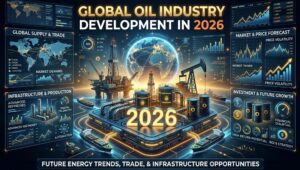
1. Global Oil Industry Development in 2026
Source : Chatgpt
The global oil industry continues to evolve in response to changing energy needs and international economic conditions. Countries with major industrial activities still require reliable oil supplies to support infrastructure, transportation, aviation, shipping, and manufacturing.
Oil demand is also closely connected to economic growth. When industrial activity and international trade increase, fuel consumption generally rises. Conversely, an economic slowdown can reduce energy consumption and put pressure on crude oil prices.
In addition to demand, global oil production plays an essential role in determining market balance. Producing countries must consider production capacity, operating costs, infrastructure investment, and long-term reserve management.
These developments make the oil industry a highly dynamic business sector. Companies and investors need to understand market changes to develop effective strategies and identify potential opportunities.
2. Global Energy Trends Shaping the Future of Oil
The future of the oil industry cannot be separated from changes in global energy trends. Several developments are expected to continue influencing the direction of the oil and gas market.
A. Growing Global Energy Demand
Population growth, urbanization, and industrial expansion are creating substantial demand for energy. Developing economies require reliable energy supplies to support infrastructure development, transportation networks, and economic activities.
Crude oil remains important, particularly in aviation, heavy transportation, shipping, and the petrochemical industry.
B. The Transition Toward Renewable Energy
Solar power, wind energy, hydrogen, and energy storage technologies are receiving increasing attention worldwide. These developments are encouraging oil companies to adjust their business models.
Many energy companies are beginning to diversify their portfolios. Instead of relying entirely on oil and gas, they are exploring investment opportunities in low-carbon technologies and alternative energy solutions.
C. The Growth of Electric Vehicles
The expansion of electric vehicles could gradually change global fuel consumption patterns. As electric vehicle adoption increases, demand for gasoline and diesel in passenger transportation may experience significant changes.
However, the impact will vary across different markets. Infrastructure availability, vehicle prices, energy policies, and consumer purchasing power will influence the speed of adoption.
D. Increasing Demand for Petrochemical Products
Crude oil is not used exclusively as a fuel. It is also an important raw material for producing plastics, synthetic fibers, lubricants, chemicals, and various industrial products.
As a result, developments in the petrochemical sector remain an important factor when analyzing the long-term outlook for global oil demand.
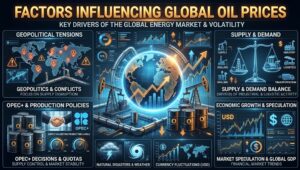
3. Factors Influencing Global Oil Prices
Source : Chatgpt
Global oil prices fluctuate due to a combination of economic, political, and industrial factors. Understanding these influences is essential for energy companies, commodity traders, and investors.
A. Global Oil Supply and Demand
Supply and demand are among the most important factors determining crude oil prices.
When demand increases while production remains limited, oil prices may rise. On the other hand, an increase in supply that is not matched by stronger demand can put downward pressure on prices.
B. Production Policies of Major Oil-Producing Countries
Decisions made by major oil-producing countries, including OPEC+ members, can significantly influence global supply.
Changes in production targets, supply restrictions, and production increases can affect market balance and international crude oil prices.
Businesses and investors should monitor these developments because production decisions can have a direct impact on the global energy market.
C. Geopolitical Conditions
International conflicts, regional tensions in major oil-producing areas, economic sanctions, and disruptions to trade routes can create uncertainty in global oil supply.
When the market anticipates potential distribution disruptions, crude oil prices may experience increased volatility.
D. The Value of the US Dollar
International crude oil is generally traded in US dollars. Therefore, changes in the value of the dollar can influence oil prices for buyers using other currencies.
A stronger US dollar can make oil more expensive for some importing countries, while a weaker dollar may create different conditions for purchasing power and international trade.
E. Global Economic Growth
Global economic conditions have a close relationship with energy consumption. Strong economic growth can increase demand for fuel and industrial raw materials.
Conversely, high inflation, interest rate changes, slower international trade, and declining manufacturing activity can weaken the outlook for oil demand.
4. Global Oil Price Analysis and Market Outlook for 2026
Global oil prices remain a major concern for energy companies, commodity traders, and investors. International crude oil markets generally use two major benchmarks: Brent Crude and West Texas Intermediate (WTI).
Brent is widely used as an international oil pricing benchmark, while WTI serves as one of the primary reference prices for the United States market.
In 2026, the oil market faces pressure from supply disruptions and geopolitical uncertainty. In its September 2026 report, the International Energy Agency (IEA) projected that global oil demand would decline by approximately 2.5 million barrels per day during the year, while global supply was expected to fall by around 5.7 million barrels per day. The IEA also reported that North Sea Dated crude averaged approximately US$91 per barrel in August 2026.
These conditions demonstrate that oil prices are influenced not only by consumer demand but also by distribution reliability, production capacity, and stability in major oil-producing regions.
What Is the Future Outlook for Global Oil Prices?
Several scenarios may influence future oil price movements:
- Prices may increase if supply disruptions continue, geopolitical conflicts expand, or global energy demand strengthens.
- Prices may stabilize if production and consumption become more balanced and international distribution improves.
- Prices may decline if global supply increases, economic growth slows, or fuel consumption weakens.
Oil price forecasts should not rely on a single indicator. Investors and businesses need to monitor oil inventory reports, production data, producer policies, and global economic developments.
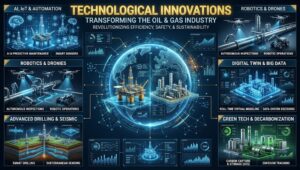
5. Technological Innovations Transforming the Oil and Gas Industry
Source : Chatgpt
Technology is becoming an important factor in improving the competitiveness of the global oil industry. Energy companies are increasingly adopting digital systems to reduce costs, improve productivity, and optimize asset management.
Several innovations are expected to play an increasingly important role.
A. Artificial Intelligence (AI)
Artificial Intelligence can help oil companies analyze operational data, predict maintenance requirements, and identify potential production problems.
By processing information more efficiently, AI allows companies to make more informed decisions based on operational conditions.
B. Internet of Things (IoT)
IoT technology connects industrial equipment through networked sensors. These systems can monitor pressure, temperature, oil flow, and machinery conditions in real time.
This type of monitoring helps companies reduce equipment failure risks and improve operational efficiency.
C. Automation and Robotics
Robotics and automation help companies perform tasks in difficult-to-access locations or environments with elevated safety risks.
These technologies can be applied to pipeline inspections, offshore facility monitoring, and industrial equipment maintenance.
D. Digital Twin Technology
Digital twin technology creates a virtual representation of physical facilities or industrial processes.
Companies can use digital models to conduct simulations, test different scenarios, and estimate the impact of operational changes before implementing them in real-world facilities.
E. Carbon Emission Reduction Technologies
The oil industry is also facing growing pressure to reduce its environmental impact. Technologies such as carbon capture, utilization and storage (CCUS), energy efficiency systems, and emissions monitoring can become important components of corporate transformation strategies.
6. Business Opportunities in the Global Oil Industry
The oil industry has an extensive business value chain. Opportunities are not limited to companies that own oil fields or large-scale production facilities. Many supporting activities can also be developed by small, medium-sized, and large businesses.
A. Oil Distribution and Trading
Fuel distribution and petroleum product trading are essential parts of the global energy supply chain.
These activities include storage, transportation, terminal management, and the distribution of petroleum products to industrial consumers.
The sector offers various opportunities, although businesses must understand licensing requirements, safety standards, infrastructure needs, and applicable trading regulations.
B. Oil and Gas Support Services
Oil companies require a wide range of supporting services to maintain efficient operations.
Examples of potential business opportunities include:
- Industrial machinery and equipment maintenance.
- Industrial components and spare parts supply.
- Oil and gas facility inspection services.
- Workplace safety consulting.
- Industrial monitoring technology.
- Environmental and waste management services.
Support service businesses can become attractive opportunities because energy companies regularly require professional partners to maintain their operations.
C. Investing in Energy Company Stocks
Investors can gain exposure to the oil industry through shares of companies involved in exploration, production, refining, and energy distribution.
The performance of these companies may depend on crude oil prices, production costs, debt levels, corporate strategies, and broader market conditions.
Before investing, individuals should review financial statements, cash flow, debt ratios, and the company’s long-term business prospects.
D. Petrochemical Business Opportunities
Petrochemical products are widely used in plastics, textiles, packaging, automotive manufacturing, and various industrial sectors.
Demand for these materials creates opportunities for companies involved in production, distribution, processing, and trading of petroleum-based chemicals.
E. Digital Technology for the Energy Industry
Digital transformation is creating new business opportunities for technology companies.
Software development, cybersecurity, industrial data analytics, sensor systems, and energy management platforms can become valuable services for the oil and gas sector.
Businesses that provide effective solutions for reducing operating costs and improving productivity may have opportunities to establish long-term partnerships with energy companies.
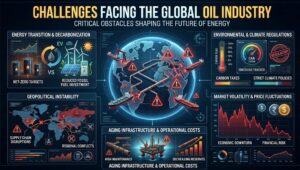
7. Challenges Facing the Global Oil Industry
Source : Chatgpt
Despite its significant economic potential, the global oil industry faces several challenges that may influence long-term business sustainability.
A. Geopolitical Uncertainty
International conflicts and regional tensions can disrupt oil production and distribution. Disruptions to strategic shipping routes may also increase transportation and insurance costs.
B. Oil Price Volatility
Rapid changes in crude oil prices can affect corporate revenue and profitability. Producers with high operating costs may experience greater financial pressure when prices decline.
For this reason, companies need effective risk management strategies, including financial planning and careful operating cost management.
C. Competition from Renewable Energy
The growth of renewable energy is creating new competitive pressures across the energy sector.
Oil companies must adapt their business strategies to remain competitive amid changing technologies, consumer preferences, and energy policies.
D. Environmental Issues and Regulations
Regulations covering carbon emissions, workplace safety, waste management, and environmental protection can influence operating costs.
Companies that fail to meet applicable environmental standards and regulatory requirements may face significant business challenges.
E. High Investment Requirements
Oil exploration and production require substantial capital, specialized technology, skilled professionals, and long development periods.
Errors in estimating reserves, project costs, or future market conditions can result in significant financial losses.
8. Strategies for Building a More Competitive Oil Business
As the global market continues to change, energy companies need flexible strategies that prioritize efficiency and long-term competitiveness.
The following strategies can help businesses respond to industry developments:
- Conduct regular market analysis. Understanding demand, supply, and oil price movements helps companies make better business decisions.
- Adopt digital technologies. AI, IoT, and automation can improve productivity while reducing operational costs.
- Expand business networks. Partnerships with suppliers, distributors, technology companies, and industrial consumers can strengthen market positions.
- Manage financial risks. Companies should account for oil price fluctuations, operating expenses, currency movements, and capital requirements.
- Improve safety and environmental standards. Responsible operational management can strengthen trust among business partners and customers.
- Develop business diversification. Depending on their capabilities and market opportunities, companies can explore energy services, petrochemicals, industrial technology, and low-carbon solutions.
These strategies can help businesses navigate competition and respond to long-term changes in the global energy industry.
9. The Future of the Oil Industry During the Energy Transition
Source : Chatgpt
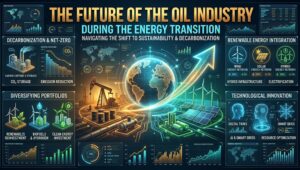
The future of the oil industry will likely depend on how effectively companies balance current energy demand with the transition toward lower-carbon energy systems.
Crude oil remains necessary for many economic activities. However, energy companies cannot ignore the development of renewable energy, electric vehicles, energy efficiency, and carbon reduction technologies.
In the coming years, energy companies may increasingly develop integrated business models. Traditional oil exploration and production activities could operate alongside investments in emerging energy technologies.
This transformation also creates opportunities for technology companies, industrial service providers, investors, and entrepreneurs who understand changing market requirements.
Ultimately, the future of the oil industry will not be determined solely by how much oil can be produced. It will also depend on how companies manage resources, improve efficiency, and adapt to changes in the global economy.
10. Tips for Taking Advantage of Oil Business and Investment Opportunities
For potential investors and entrepreneurs interested in entering the oil industry, understanding the characteristics of this sector is an essential first step.
Here are several important considerations:
- Study Brent and WTI crude oil price movements.
- Follow international energy market reports.
- Understand the oil and gas supply chain.
- Choose a business model that matches your capital and capabilities.
- Verify company legitimacy, licensing, and regulatory requirements.
- Calculate operational risks and capital requirements.
- Avoid making investment decisions based solely on price predictions.
- Diversify investments to reduce dependence on a single asset.
Oil-related businesses can offer attractive opportunities, but each business model carries different risks. Business decisions should therefore be based on research, financial calculations, and a clear understanding of applicable regulations.
Conclusion
The future of the global oil industry will continue to evolve alongside technological developments, economic dynamics, and the worldwide energy transition. Although renewable energy is expanding, crude oil remains important for transportation, manufacturing, petrochemicals, and international trade.
In 2026, oil price movements are influenced by the balance between supply and demand, production policies, geopolitical conditions, and global economic developments. These uncertainties create both challenges and opportunities for energy companies and investors.
Business opportunities extend beyond oil exploration and production. They also include distribution, support services, petrochemicals, energy stocks, and digital industrial technologies.
Looking ahead, companies that successfully combine operational efficiency, technological innovation, risk management, and strategies for adapting to the energy transition may achieve stronger competitiveness in the global market.
The global oil industry may be changing, but business opportunities remain open for companies and investors capable of understanding market trends and making strategic decisions.