
The rapid development of digital technology has brought significant changes to various industries, particularly the global financial and business sectors. One of the most influential innovations is blockchain technology. It serves as the foundation of cryptocurrency while introducing new ways to conduct transactions, store digital assets, and manage business operations more efficiently.
In recent years, cryptocurrency has become an increasingly recognized part of the digital economy. Bitcoin, Ethereum, and other crypto assets have attracted the attention of investors, technology companies, and financial institutions worldwide. However, the impact of blockchain extends far beyond digital asset trading.
Blockchain offers a decentralized record-keeping system that is difficult to manipulate and allows transactions to be verified across a network. These characteristics create opportunities for more efficient financial services, faster cross-border transactions, and innovative business models.
So, how is the blockchain revolution transforming the global financial system and business landscape? What opportunities does it create, and what challenges should businesses and investors understand? Let’s explore the key developments.
1. Understanding Blockchain Technology and Cryptocurrency
Before examining its impact on the global economy, it is important to understand the relationship between blockchain and cryptocurrency.
Blockchain is a digital data storage technology that uses a distributed ledger system. Transaction information is stored in blocks connected through cryptographic mechanisms. Each block is linked to the previous one, creating a chain of records that can be verified by the network.
Unlike traditional databases, which are generally controlled by a central authority, public blockchains allow multiple network participants to verify transactions according to established protocol rules.
Cryptocurrency, meanwhile, refers to digital assets that use cryptographic technology to support transaction security and ownership management. Many cryptocurrencies rely on blockchain as their underlying technology.
Some of the most widely recognized cryptocurrencies include:
-
Bitcoin (BTC): A digital asset designed as a peer-to-peer electronic cash system.
-
Ethereum (ETH): A blockchain platform that supports smart contracts and decentralized applications.
-
Solana (SOL): A blockchain network designed to support digital transactions and applications with high processing capacity.
-
XRP: A digital asset developed to support value transfers and payment-related activities.
Although these assets have different functions and characteristics, they demonstrate how blockchain can support various applications within the digital economy.
2. How Blockchain Is Transforming the Global Financial System
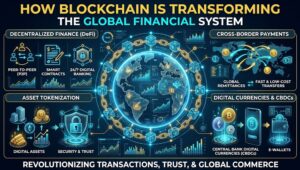
Source : Chatgpt
The financial industry is one of the sectors experiencing significant changes due to blockchain technology. Traditional financial systems often involve several intermediaries, including banks, payment providers, and transaction-processing companies.
Blockchain introduces a different approach by allowing digital transactions to be verified through decentralized networks without always relying on a single central institution.
Here are some of the major developments.
A. Cross-Border Digital Transactions
International money transfers often involve multiple financial institutions. These processes may require additional processing time, administrative fees, and verification procedures.
Blockchain technology enables digital assets to move through networks that operate globally. Depending on the network and transaction conditions, transfers can sometimes be completed faster than certain traditional payment methods.
This creates opportunities for international companies, cross-border workers, and digital businesses to develop more flexible payment systems.
However, transaction speed still depends on the blockchain network, network congestion, transaction fees, and the process of converting digital assets into local currencies.
B. More Transparent Payment Systems
Transparency is one of the key characteristics of blockchain technology. Transactions recorded on public blockchains can be examined through blockchain explorers, allowing users to verify transaction information.
This capability creates opportunities to improve the traceability of digital assets.
In business operations, blockchain transparency can support auditing, payment records, and transaction verification. However, public transaction records do not automatically reveal the real-world identities of users or guarantee that the source of funds can always be identified.
C. Reducing Dependence on Intermediaries
Blockchain enables peer-to-peer transactions, allowing users to exchange digital assets directly through a network.
In certain systems, smart contracts can automatically execute transactions when predefined conditions are fulfilled.
This approach may reduce the need for some intermediaries and administrative processes. Nevertheless, specific financial services may still require custodians, liquidity providers, identity verification systems, and other institutions to maintain security and regulatory compliance.
3. Cryptocurrency and the Growth of the Digital Economy
Cryptocurrency has developed into an important part of the digital financial industry. In addition to being used as an investment asset, cryptocurrency supports a broader technology ecosystem that enables various economic activities.
This development creates several opportunities.
A. The Emergence of Alternative Digital Assets
Bitcoin is often considered a digital asset with characteristics that differ from traditional financial instruments. Its protocol limits the maximum supply to 21 million coins.
This limited supply has attracted investors interested in diversifying their portfolios.
However, cryptocurrency markets are highly volatile. Prices can change significantly within a short period, making it essential for investors to understand the risks before making financial decisions.
B. The Growth of Decentralized Finance (DeFi)
Decentralized Finance, commonly known as DeFi, refers to a blockchain-based financial ecosystem that uses smart contracts to provide various services.
Some services available within the DeFi ecosystem include:
-
Digital asset lending and borrowing.
-
Cryptocurrency exchanges through decentralized exchanges.
-
Liquidity provision.
-
Digital asset management.
-
Smart contract-based financial transactions.
DeFi provides alternatives to certain conventional financial services. However, users should understand potential risks involving smart contract vulnerabilities, market manipulation, liquidity problems, and asset losses.
C. The Development of Stablecoins
Stablecoins are cryptocurrencies designed to maintain a relatively stable value by referencing specific assets, such as fiat currencies.
Some stablecoins, for example, are designed to maintain a value linked to the US dollar.
Stablecoins can potentially be used for digital payments, cryptocurrency trading, and cross-border transfers. However, their stability and security depend on their underlying mechanisms, reserve quality, issuer transparency, and applicable regulations.
4. The Role of Smart Contracts in Global Business Transformation

Source : Chatgpt
One of the most important innovations in blockchain technology is the smart contract.
A smart contract is a program that operates on a blockchain network and can automatically execute specific actions when predefined conditions are met.
This technology helps businesses develop more structured processes and reduce certain administrative tasks.
Examples of smart contract applications in business include:
1. International Trade
Smart contracts can be used to execute payments when specific transaction requirements are fulfilled, such as confirmation of goods received or verification of relevant documents.
2. Supply Chain Management
Companies can use blockchain to record the journey of products from manufacturers to consumers. These records can support product tracking and verification.
3. Real Estate Industry
Blockchain technology can support digital ownership records and the development of property tokenization systems, subject to applicable legal requirements.
4. Digital Industries
Smart contracts can be used to manage royalty distribution, digital transactions, and access rights within certain platforms.
When implemented properly, smart contracts can improve operational efficiency and reduce dependence on manual processes.
5. Asset Tokenization: New Opportunities in the Investment Industry
Real-world asset tokenization is the process of representing rights or interests in specific assets through digital tokens on a blockchain network.
Potential assets for tokenization include:
-
Gold and precious metals.
-
Real estate and property.
-
Bonds and financial instruments.
-
Commodities.
-
Artworks and collectible assets.
For example, a company may develop digital tokens that represent ownership interests or claims on physical gold held in secure storage.
Through this system, investors may gain access to certain assets using digital mechanisms.
However, tokenization does not automatically provide legal ownership of the underlying physical asset. Investor rights must be supported by clear agreements, reliable custodians, redemption mechanisms, and legal protections.
With appropriate governance, tokenization could become an important innovation connecting traditional asset markets with the digital economy.
6. Cryptocurrency and Blockchain Business Opportunities

Source : Chatgpt
The blockchain revolution does not only create opportunities for investors. It also opens new business possibilities for companies, startups, and digital entrepreneurs.
Here are several sectors with significant development potential.
A. Blockchain Application Development
Growing demand for blockchain-based applications creates opportunities for software developers.
Businesses can focus on building decentralized applications (dApps), digital payment systems, smart contracts, and digital asset management platforms.
Expertise in blockchain programming, cybersecurity, and application development is essential for entering this industry.
B. Blockchain Consulting Services
Not every company has the technical capabilities to implement blockchain technology independently.
This creates opportunities for consulting businesses that help organizations understand their requirements, select appropriate blockchain networks, integrate systems, and evaluate security.
C. Cryptocurrency Education
Growing public interest in cryptocurrency creates demand for accessible and reliable information.
Educational businesses can be developed through blogs, websites, online courses, webinars, and social media content.
Educational topics may include blockchain fundamentals, digital wallet security, risk management, and cryptocurrency market analysis.
It is important to distinguish financial education from unrealistic promises of guaranteed investment returns.
D. Digital Infrastructure and Cybersecurity
Security is one of the most important requirements within the blockchain ecosystem.
Business opportunities may include smart contract auditing, application security testing, digital wallet development, and transaction monitoring systems.
Companies that provide reliable security solutions play an important role in supporting the growth of the blockchain industry.
E. Digital Payment Platforms
Blockchain and stablecoins can be used to develop digital payment infrastructure.
Service providers can build solutions that help businesses manage transactions, international payments, and digital asset integration.
However, payment-related businesses must consider licensing requirements, regulatory compliance, consumer protection, and financial regulations in every operating market.
7. Challenges and Risks of Blockchain Technology
Despite its significant potential, blockchain technology and cryptocurrency still face several challenges.
Understanding these risks is essential before using digital assets for business or investment purposes.
A. Cryptocurrency Price Volatility
Cryptocurrency prices can change rapidly due to market conditions, investor sentiment, technological developments, and global economic factors.
This volatility may create trading opportunities, but it also increases the possibility of financial losses.
Investors should avoid using essential living expenses or emergency funds for speculative cryptocurrency trading.
B. Cybersecurity Threats
The cryptocurrency ecosystem faces various security threats, including phishing attacks, private key theft, investment scams, and smart contract exploits.
If someone gains unauthorized access to a digital wallet, the owner may lose funds that are difficult or impossible to recover.
Therefore, users should protect their private keys, enable additional authentication, and carefully evaluate the security of platforms before using them.
C. Regulation and Compliance
Cryptocurrency and blockchain regulations vary across countries.
Companies operating in the digital asset industry must understand applicable requirements involving licensing, taxation, anti-money laundering, consumer protection, and transaction reporting.
Regulatory compliance is an important factor in building a sustainable blockchain business.
D. Network Scalability
Not all blockchain networks have the same transaction-processing capacity.
When user activity increases, some networks may experience congestion, affecting transaction speeds and fees.
Technologies such as layer-2 solutions, protocol upgrades, and new consensus mechanisms are being developed to address these challenges.
E. Limited User Understanding
Many people still lack a clear understanding of blockchain, cryptocurrency, and digital asset security.
Limited knowledge can increase the risk of scams, transaction mistakes, and investment decisions based on insufficient information.
Education is essential to ensure that blockchain technology can be used more responsibly.
8. The Impact of Blockchain on the Future of Global Business

Source : Chatgpt
Blockchain has the potential to influence how companies manage transactions, store information, build customer relationships, and develop digital products.
Businesses are not only expected to follow technological developments but also need to understand how these innovations can create practical benefits for their operations.
Several potential developments include:
Financial process digitalization: Companies can use blockchain-based systems to improve transaction recording and verification.
Supply chain transparency: Product journey information can be recorded and verified through blockchain networks.
Access to digital assets: Tokenization can introduce new approaches to managing and distributing interests in specific assets.
International collaboration: Blockchain infrastructure enables the development of digital services that can operate across different regions.
New business models: Companies can develop services based on smart contracts, decentralized applications, and digital payment infrastructure.
Nevertheless, successful blockchain adoption depends on business requirements, technology quality, user readiness, and regulatory certainty.
9. Strategies for Taking Advantage of Blockchain and Cryptocurrency Opportunities
Businesses interested in entering the blockchain industry need a well-planned strategy to take advantage of emerging opportunities.
Here are several important steps to consider.
1. Learn the fundamentals of blockchain technology. Understand how blockchain networks, cryptocurrencies, smart contracts, and digital asset security work.
2. Choose a business sector. Identify an area that matches your capabilities, such as application development, consulting, education, digital payments, or cybersecurity.
3. Conduct market research. Identify customer needs, competition levels, revenue potential, and industry challenges.
4. Build a strong security system. Implement data protection, system audits, multi-factor authentication, and secure digital asset management procedures.
5. Understand regulatory requirements. Ensure that business activities comply with the applicable laws and regulations in each operating market.
6. Continuously develop your skills. The blockchain industry evolves rapidly, making it important to follow technological innovations and market developments.
7. Manage financial risks. Avoid making decisions based solely on temporary market trends. Evaluate capital requirements and potential losses realistically.
With a well-structured approach, businesses can use blockchain as a supporting technology to create more innovative services.
10. The Future of Blockchain and Cryptocurrency

Source : Chatgpt
The future of blockchain and cryptocurrency will be influenced by technological progress, market demand, corporate adoption, and regulatory developments across different regions.
Several trends worth watching include the growing use of stablecoins, the development of real-world asset tokenization, the integration of blockchain with artificial intelligence, and improvements in digital payment infrastructure.
Interoperability is also becoming an important area of development. This technology aims to enable different blockchain networks to communicate and exchange information or assets.
At the same time, improvements in security and user experience will play an important role in expanding blockchain adoption.
For businesses, the greatest opportunities may not come solely from cryptocurrency trading but also from developing solutions that address real problems in economic activities.
Blockchain has considerable potential, but its long-term success will require innovation, effective governance, security, and user trust.
Conclusion
The blockchain revolution has introduced significant changes to the global financial system and business landscape. Through distributed ledger technology, cryptocurrency, smart contracts, DeFi, and asset tokenization, blockchain creates new opportunities for digital transactions and the development of the modern economy.
For businesses, this technology can improve transparency, support digital financial services, and create more innovative business models. For investors, cryptocurrency and digital assets offer alternative investment opportunities with unique characteristics and risks that require careful consideration.
Nevertheless, challenges such as price volatility, cybersecurity threats, regulatory uncertainty, and network scalability remain important factors to consider.
Ultimately, the future of blockchain will not be determined by cryptocurrency development alone. Its long-term impact will depend on how effectively this technology delivers real value to individuals, businesses, and the global financial industry.